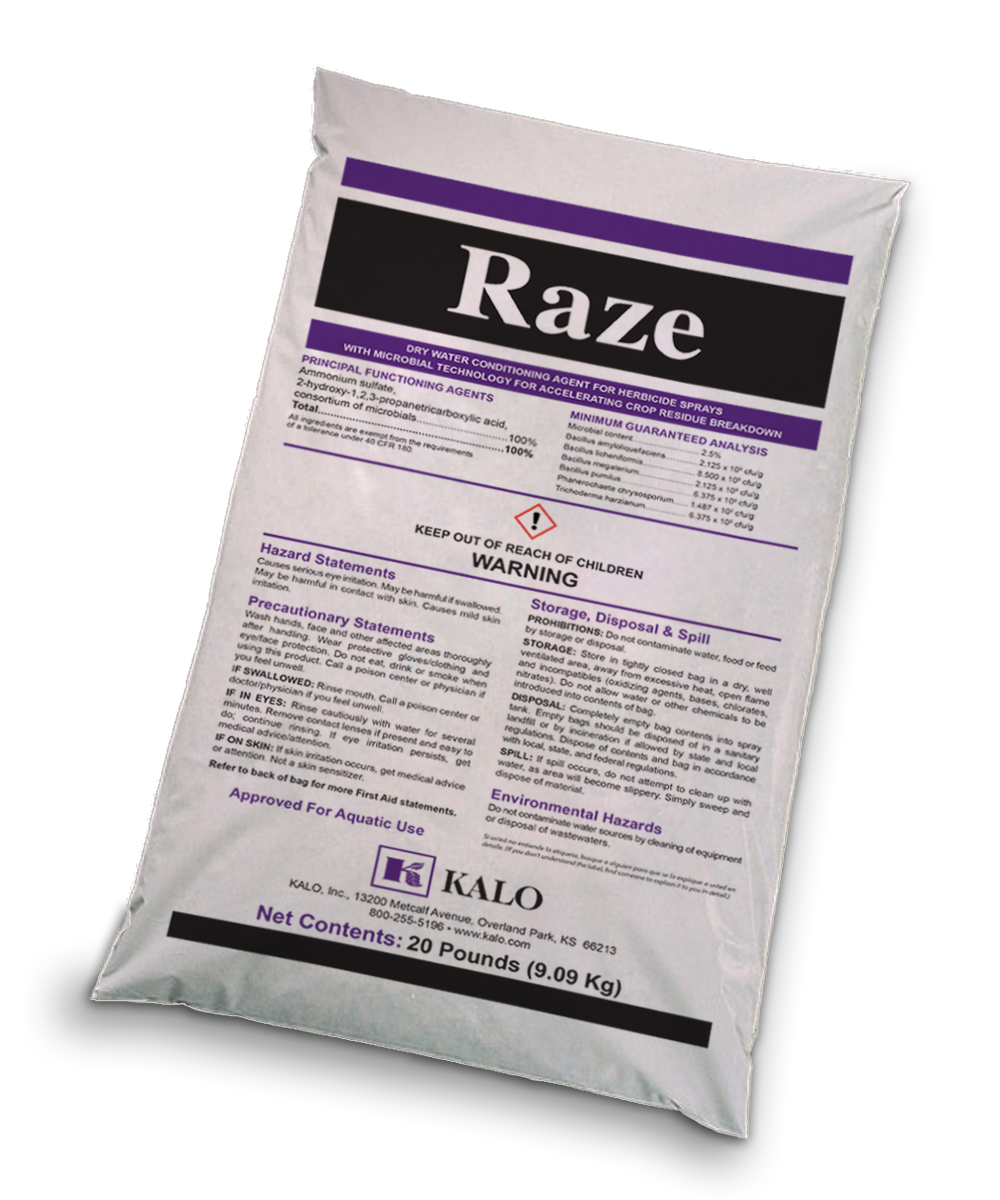
Dry, Water Conditioning Agent for Herbicide Sprays with Microbial Technology for Accelerating Crop Residue Breakdown
Raze is a water conditioning adjuvant system along with a proprietary consortium of microorganisms to hasten the natural breakdown and conversion of crop residue into nutrient rich soil organic matter.
The Microbial Technology consists of a premium blend of microorganisms and fungi that actively break down crop residue while cycling nutrients for subsequent uptake. The Microbial Technology is a proven microbial collection that is used on millions of acres annually. Accelerated breakdown of crop residue allows for more carbon to be captured and recycled to build soils, increase nutrient availability, and enhance plantability for greater yield potential.
Raze is suitable for use alone or in tank mix applications with burn down herbicides such as glyphosate, 2,4-D, and others requiring AMS or water conditioning to prevent hard water antagonism.
The sulfur in Raze serves as an important food source for bacteria to multiply and is a key component for protein synthesis both for plants and bacteria.
Raze is a spray-grade formulation that readily dissolves in water to neutralize antagonism from hard water minerals such as iron, calcium and magnesium.
When used at the labeled rate, Raze delivers equivalent water conditioning and chelating performance of up to 2% by weight (w/w) of ammonium sulfate spray solutions.
Raze is compatible with a wide range of crop protection inputs and can be used with additional tank mixed spray adjuvants such as nonionic surfactants and drift control agents as needed.
Crop residue that has been sprayed with Raze is not harmful to livestock.
Use Rates
Ground Applications: 5 pounds per 100 gallons of water applied at 12 to 15 gallons per acre
Seasonal Applications
Fall: Apply after harvest for best performance
Spring: Apply with early herbicide application or in the termination of cover crops
Summer: Ideal for breaking down wheat stubble
Note: Specific timing for optimal use varies based on tillage practices, fertility levels and other factors
Refer to specimen label and safety data sheet for more information about this product.